The evolving role of a Product Developer in the digital economy
Introduction
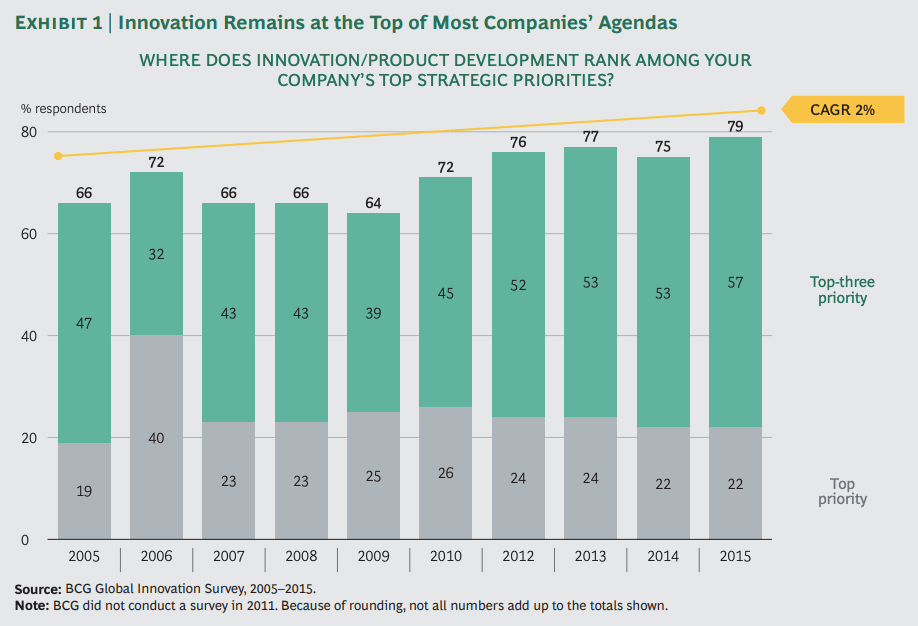
According to the Boston Consulting Group (2015), 79% of CEOs participating in a global survey report mentioned product development to be their topmost or among their top three priorities. Traditionally defined as a systematic approach consisting of ideation to implementation that Product Developers must go through to make sure a new or improved product enters the market. However, with the rapid change in digital technologies, along with innovative product offerings, the product development process also is transforming. Personally, starting my career as a Product Analyst and becoming a Digital Product and Innovation Specialist in the space of three years demonstrates how the role has changed radically with the advent of digital transformation. The following are the critical digital revolution transforming the product development process and related career roles.
Data Analytics
Data is now a core aspect of the product development process. Businesses are gathering data from different sources, intending ‘to decrease cost, increase value, and accelerate growth, as well as opportunities for customization and differentiation’ (“Design-to-value | Operations”, 2020). Product Developers today have the responsibility to use digital analytics tools combined with ethnographic research to have a deeper understanding of the users and their decision-making process (“Design-to-value | Operations”, 2020), which ultimately supports new product development.
Additionally, the array of advanced analytics evolving in this field, such as machine learning and artificial intelligence, will further enhance the capabilities of Product Developers to predict customer behaviors and patterns and help to provide customized solutions to the customer pain points in a reliable manner. Another data usage technique that is on the rise and being used by notable companies such as Netflix is Predictive Product Development (Markman, 2019), where Product Developers are being predictive instead of reactive. They are leveraging existing product information and real-world data of a product during its life cycle to precisely monitor problems and discover customers’ unmet needs in real-time (Brossard et al., 2018).

Agile Methodology
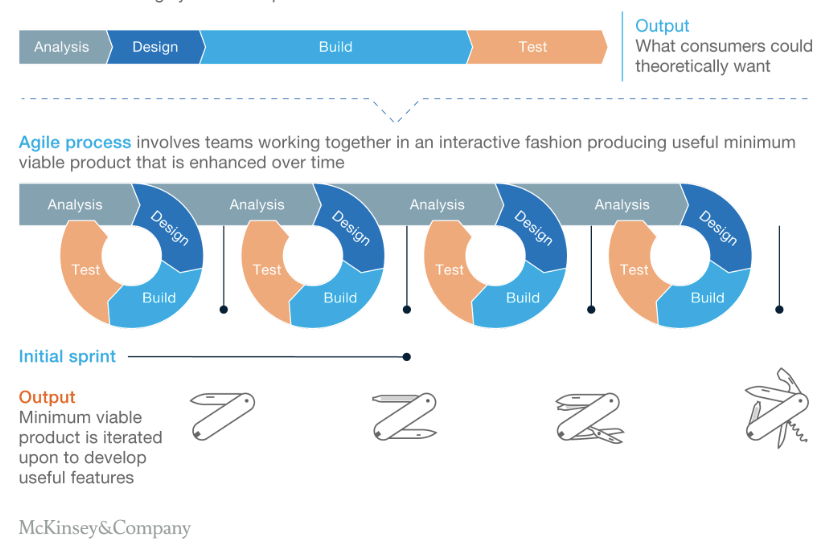
‘Innovation drives growth, but yesterday’s product development practices just aren’t delivering. It’s time to try a new recipe’ (Callaghan et al., 2018). Previously, Product Developers used to adopt a traditional model known as the waterfall process of product development, where the goal was to make the perfect product. However, with the rapidly evolving needs of customers, the notion of a “perfect product” is not valid anymore. Emerging evidence in the digital economy demonstrates that being a first mover in the market with the right product but with rough edges is better than launching a fully developed product too late (Brossard et al., 2018).
Product Developers are now expected to use an agile approach in new product development. The latter approach is a concept inspired from software developers, ‘who release beta versions of new products to get early reactions from customers, define customers’ preferences through A/B testing, and then deliver on their feedback with changes made in brief, frequent cycles’ (Brossard et al., 2018). Product Developers are expected to be agile and to discover gaps in the market quickly and react accordingly by developing or improving value propositions according to customers’ evolving needs before competitors do and customer preferences change.
Generative-design technologies
Smart algorithms are now redefining how product development is done. Product Developers devote a lot of their time into refining their best guess. But it takes a lot of time, money, and human resources to deliver those iterations (Brossard et al., 2020). With the help of today’s technology, Product Developers can explore alternative solutions that differ from their base-case assumptions. Digital simulation such as virtual reality (VR), augmented reality (AR), and 3-D printing allows Product Developers to evaluate designs in seconds.
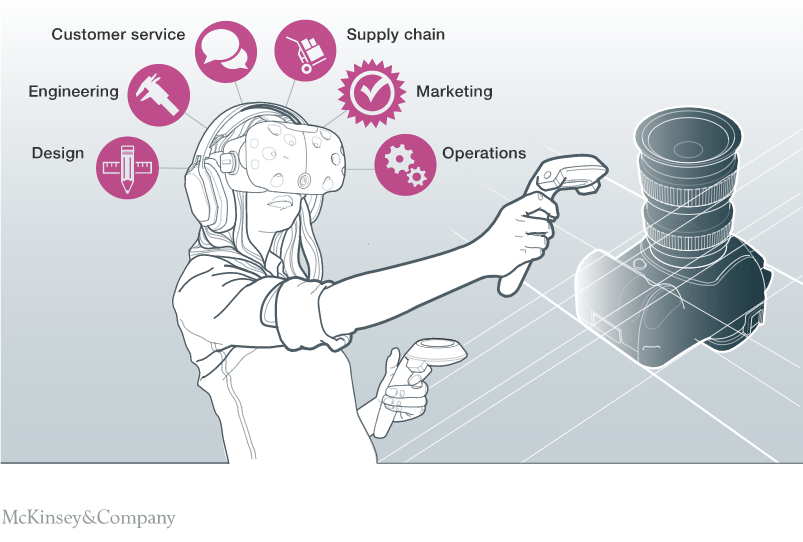
Also, the use of artificial intelligence techniques provides a multitude of possible solutions that Product Developers may explore while comparing the results of thousands of simulations to achieve the most favorable design for customers (Brossard et al., 2020). Although these generative-design methods can produce creative, non-intuitive solutions, Product Developers still need to validate the output through testing or analysis. This human-intervention is likely to continue as the algorithm gets smarter, and Product Developers learn to use these new tools for different applications (Brossard et al., 2020).
Conclusion
From data analytics to generative-design technologies, the importance of the agile methodology, and smart algorithms, ‘the future looks promising for innovative ideas that can improve the roles and tasks of Product Developers all over the world’ (“5 Product Development Trends to Own the Future | ALTA Digital”, 2020). It is of great importance for them to continuously learn and adopt these new trends and not be lagged. Being able to embrace these changes will keep Product Developers gliding through the emerging wave of innovation. Finally, I reckon that despite the digital disruption in the product development process, creativity remains a central aspect of a Product Developer’s role, which would be difficult to replace by technology in the near future.
_ . _ . _ ._ . _ . _ ._ . _ . _ ._ . _ . _ ._ . _ . _ ._ . _ . _ ._ . _ . _ ._ . _ . _ ._ . _ . _ ._ . _ . _ ._
References
5 Product Development Trends to Own the Future | ALTA Digital. ALTA Digital. (2020). Retrieved 14 February 2020, from https://altadigital.com/blog/product-development-trends.
Boston Consulting Group. (2015). The most innovative companies – Four factors that differentiate leaders (p. 3). Boston: The Boston Consulting Group, Inc. Retrieved from https://media-publications.bcg.com/MIC/BCG-Most-Innovative-Companies-2015.pdf
Brossard, M., Erntell, H., & Hepp, D. (2018). Accelerating product development: The tools you need now. McKinsey & Company. Retrieved 14 February 2020, from https://www.mckinsey.com/business-functions/operations/our-insights/accelerating-product-development-the-tools-you-need-now.
Brossard, M., Gatto, G., Gentile, A., Merle, T., & Wlezien, C. (2020). How generative design could reshape the future of product development. McKinsey & Company. Retrieved 14 February 2020, from https://www.mckinsey.com/business-functions/operations/our-insights/how-generative-design-could-reshape-the-future-of-product-development.
Callaghan, S., Henrich, J., & O’Neill, B. (2018). Get better products faster with a new and improved R&D formula. McKinsey & Company. Retrieved 14 February 2020, from https://www.mckinsey.com/business-functions/operations/our-insights/get-better-products-faster-with-a-new-and-improved-rd-formula.
Design-to-value | Operations. McKinsey & Company. (2020). Retrieved 14 February 2020, from https://www.mckinsey.com/business-functions/operations/how-we-help-clients/product-development-procurement/design-to-value.
Markman, J. (2019). Netflix Harnesses Big Data To Profit From Your Tastes. Forbes.com. Retrieved 14 February 2020, from https://www.forbes.com/sites/jonmarkman/2019/02/25/netflix-harnesses-big-data-to-profit-from-your-tastes/#77c6008266fd.
Follow My Blog
Get new content delivered directly to your inbox.
 Antish Aubeelock
Hi Antish, very interesting piece! I definitely agree that the new technologies arising in our Digital Economy will not be a sounds replacement for creativity. In fact, I believe due to the fact such technologies as AI and machine learning will make menial tasks of a Product Developer easier and less time, that it will allow them to exceed creative boundaries because there is more time to analyze the consumer data coming in and come up with an interesting strategy or product idea. I wonder however, if the same will apply in the context of a new service. Many brand design experts think that we have reached the peak in terms of inventing, so we are in a new area of re-inventing. Do you think this factor will cap our creative abilities or do you think that AI could allow us to break out of it and re-establish a new peak of innovation?
LikeLike
This blogpost provides a succinct overview of the productive benefits of technologies for the Product Developer’s role, using data analytics to predict changing customer behaviours ahead of time and thereby allowing Developers to stay ahead of the market. However, as you point out, creativity remains a central aspect of the role. Identifying behaviours ahead of time is beneficial from a strategic perspective, however it does not account for the complex design process that must follow thereafter; from conceptualisation, detailed design work and prototypes, collaboration with engineers and technical specialists, and negotiations that take place between teams and decision makers. With this, I would also add that with the growing trend being “to follow the talent”, product development teams are becoming increasingly dispersed, therefore the Product Developer of today must be able to adapt to advanced collaboration tools as processes become ever more trying across many different locations and time-zones (https://altadigital.com/blog/product-development-trends).
LikeLike
I couldn’t agree with you more. In the current era of big data, indeed, new technologies emerging in the digital economy will not wholly replace ideas. In product development, demand drives product development. This data superimposed sampling used to determine the direction of the product quickly.But it is only a quick judgment of the trend, if there is no good idea, developed new products still can not arouse the desire of customers to buy.
But on the other hand, innovation is the root of technology. Technology cannot replace change, but technology itself needs innovation. Innovation is the source of technological progress. Artificial intelligence is an innovation that can replace some of today’s technologies, but it is also a technology in itself. Big data provides the foundation for artificial intelligence, which is a technology in itself. The combination of the two is innovation, and new technology also achieve. So do you think that in terms of product innovation, you can not only innovate in product development but also innovate in the technology of product development as a model of product development and innovation?
LikeLike
Antish, your passage provides a brilliant summary of how digital technology transformed the role of product developers. I am especially intrigued by the idea of generative-design technologies like VR and AR, of how product developers can immediately evaluate their designs and make subsequent adjustments. In my opinion, I believe that such technologies can be utilized to design customized products that highly suit customers’ needs, and highly elevate the quality of products in the future. On top of that, I also agree that creativity is an indispensable attribute in the field of product development, which cannot be easily replaced by machines or any kind of technologies. Speaking of which, do you think that digital technologies are likely to inspire creativity among product developers through accelerating and assisting the designing processes, or the process of developing and deploying creativity will be hampered by such digital transformation?
LikeLike
Hello Antish,
Your post proves to be very useful to understand the opportunities offered by predictive analysis tools and AI in product development. It appears that the success of a firm will increasingly rest on their prophetic ability, “predictivity” instead of “reactivity”, resulting in a gain in term of efficiency, costs and productivity.
However, to behold this horizon raises a philosophical question. Efforts to introduce data analytics and AI claim to be customer centric but will operate incrementally without any human intervention. On a long-time scale, man risks to stop being the homo faber of Hannah Arendt, as he found substitutes to human creativity to achieve innovation.
You stated that product developers will retain their ability to intervene in the creation. I would be interested if you have further insights from your past experience to share on how product developers will continue to be creators in the digital era.
LikeLike
A timely piece of write-up with coherent examples of digitalisation of product development. I agree with the quotation of Callaghan on innovation that yesterday’s product development practices just aren’t delivering, and it’s time to try a new recipe. You have described the process of agility that drives growth, which focuses on the evolving needs of the customer and develops the value chain accordingly. Agility is indeed a process of flowing freely with technology at its core. However, the agile process accentuates responding to the need for change over the period. Too much focus on doing modifications lets project managers concentrate more on unit deliverables than planning as a whole. This can result in fragmented output. Moreover, shifting workflow makes it tough to set one definite KPI for the project from the very beginning. So, do you think the agile methodology can be successful for the long-term strategy?
LikeLike
Antish, indeed digitalization has had a significant contribution to the advancement of product development. The level with which technology has been used to enhance quality products to fit the needs of society is tremendous. From your blog, it is necessary to have the current and future generations focusing more on the technological know-how to ensure that their expertise remains relevant in the market. The exploitation of Artificial Intelligence shall, for sure, transform the society into one with more content creators than managers hence the creation of more solutions to societal problems. Innovation is an essential aspect since it is based on the development of products that will ensure the day-today activities are simplified and time is saved.
LikeLike